Weddingharmony

Followers

Monday, April 2, 2012

Wedding Dress

wedding dress or wedding gown is the clothing worn by a bride during a wedding ceremony. Color, style and ceremonial importance of the gown can depend on the religion and culture of the wedding participants. In Western culture brides often choose a dress of white to symbolize purity of the soul, and the dress may form part of a bride's trousseau. In eastern cultures, brides often choose red to symbolize auspiciousness.


Western Culture :

Weddings performed during and immediately following the Middle Ages were often more than just a union between two people. They could be a union between two families, two businesses or even two countries. Many weddings were more a matter of politics than love, particularly among the nobility and the higher social classes. Brides were therefore expected to dress in a manner that cast their families in the most favorable light, for they were not representing only themselves during the ceremony. Brides from wealthy families often wore rich colors and exclusive fabrics. It was common to see them wearing bold colors and layers of furs, velvet and silk.
The woman to the far right is wearing a typical wedding dress from 1929. Until the late 1930s, wedding dresses reflected the styles of the day. From that time onward, wedding dresses have traditionally been based on Victorian styles.
Over the centuries, brides continued to dress in a manner befitting their social status—always in the height of fashion, with the richest, boldest materials money could buy. The poorest of brides wore their best church dress on their wedding day. The amount of material a wedding dress contained also was a reflection of the bride's social standing and indicated the extent of the family's wealth to wedding guests. Today, there are wedding dresses available in all price ranges, and Western traditions have loosened up to include a rainbow of colors and variety of lengths, which are now considered acceptable. Women may purchase ready-made gowns, wear a family heirloom, or they may choose to have a dressmaker create one for her. In addition, today many bridal salons have samples of wedding gowns in their stores where the bride selects a certain style and orders one to be made to fit.
Wedding dresses have traditionally been based on the popular styles of the day. For example, in the 1920s, wedding dresses were typically short in the front with a longer train in the back and were worn with cloche-style wedding veils. This tendency to follow current fashions continued until the late 1940s, when it became popular to revert to long, full-skirted designs reminiscent of the Victorian era. Although there has always been a style that dominates the bridal market for a time, and then shifts with the changes in fashion, a growing number of modern brides are not choosing to follow these trends. This is due in large part to non-traditional and non-first-time weddings, and women who are marrying later in life.
Today, Western wedding dresses are usually white though "wedding white" includes shades such as eggshell, ecru and ivory. Lowering wedding costs by selecting a second hand wedding dress rather than purchasing a new one is a growing trend.
Mary, Queen of Scots, wore a white wedding gown in 1559 when she married her first husband, Francis Dauphin of France because it was her favorite color, although white was then the color of mourning for French Queens. The first documented instance of a princess who wore a white wedding gown for a royal wedding ceremony is that of Philippa of England, who wore a tunic with a cloak in white silk bordered with grey squirrel and ermine in 1406.
White did not become a popular option until 1840, after the marriage of Queen Victoria to Albert of Saxe-Coburg. Victoria wore a white gown for the event to incorporate some lace she prized. The official wedding portrait photograph was widely published, and many other brides opted for white in accordance with the Queen's choice.
The tradition continues today in the form of a white wedding, though prior to the Victorian era, a bride was married in any color, black being especially popular in Scandinavia. Later, many people assumed that the color white was intended to symbolize virginity, though this was not the original intention. (It was the color blue that was connected to purity.) The white gown is in fact a symbolic Christening gown. They are a variation of the white surplice worn in the Western Catholic tradition by members of the clergy, church choirs and servers and the gowns worn by girls making their first communion and at their confirmation and also by women making religious vows. Jews have gone to great lengths  to follow these Western (Judeo-Christian) customs, whilst adhering to the laws of Tzniut. Today, the white dress is understood merely as the most traditional and popular choice for weddings.
Eastern Culture :
Many wedding dresses in China, India (wedding sari) and Vietnam (in the traditional form of the Ao dai) are colored red, the traditional color of good luck and auspiciousness. Nowadays, many women choose other colors besides red. In modern mainland Chinese weddings, the bride may opt for Western dresses of any color, and later don a traditional costume for the official tea ceremony.
Qing dynasty styled traditional Chinese wedding dress with phoenix crown (鳳冠) headpiece still used in modern Taiwanese weddings. 
In modern Taiwanese weddings, the bride generally picks red (following Chinese tradition) or white (more Western) silk for the wedding gown material, but most will wear the red traditional garmet for their formal wedding banquets. Traditionally, the father of the bride is responsible for the wedding banquet hosted on the bride's side and the alcohol (specifically called "xi-jiu," confusingly the same as what the wedding banquet itself is called) consumed during both banquets. While the wedding itself is often based on the couple's choices, the wedding banquets are a symbolic gesture of "thanks" and appreciation, to those that have raised the bride and groom (such as grandparents and uncles) and those who will continue to be there to help the bride and groom in the future. Thus out of respect for the elders, wedding banquets are usually done formally and traditionally.
Red wedding saris are the traditional garment choice for brides in Indian culture. Sari fabric is also traditionally silk. Over time, color options and fabric choices for Indian brides have expanded. Today fabrics like crepe, Georgette, charmeuse, and satin are used, and colors have been expanded to include gold, pink, orange, maroon, brown, and yellow as well.Indian brides in Western countries often wear the sari at the wedding ceremony and change into traditional Indian wear afterwards (lehnga, choli, etc.).
Japanese formal wedding dress still used today.
At Japanese weddings, brides will often wear three or more dresses throughout the ceremony and subsequent celebrations with a traditional kimono, white and colour dress combination being popular. White is used, because in Japan it symbolizes death—in this case, the bride becomes dead to her family. The bride will eventually remove her white kimono to reveal another colored one—usually red—to symbolize her rebirth into her husband's family.
The Javanese people of Indonesia wear a kebaya, a traditional kind of blouse, along with batik.
In the Philippines, variations of the Baro't saya are considered to be wedding attire for women, along with the Barong Tagalog for men.

Native American Culture :
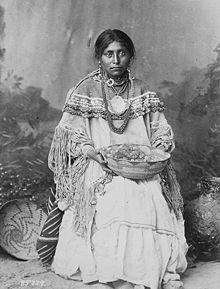
The indigenous peoples of the Americas have varying traditions related to weddings and thus wedding dresses. A Hopi bride traditionally would have her garments woven by the groom and any men in the village who wished to participate. The garments consisted of a large belt, two all-white wedding robes, a white wedding robe with red stripes at top and bottom, white buckskin leggings and moccasins, a string for tying the hair, and a reed mat in which to wrap the outfit. This outfit also would serve as a shroud, since these garments would be necessary for the trip through the underworld.
A Pueblo bride wore a cotton garment tied above the right shoulder, secured with a belt around the waist.
In the traditions of the Delaware, a bride would wear a knee-length skirt of deerskin and a band of wampum beads around her forehead. Except for fine beads or shell necklaces, the body would be bare from the waist up. If it were a winter wedding, she would wear deerskin leggings and moccasins and a robe of turkey feathers. Her face would be painted with white, red and yellow clay.
The tribes of Northern California (which include the Klamath, the Modoc and the Yurok) had a traditional bridal dress woven in symbolic colors: white for the east, blue for the south, yellow (orange) for the west; and black for the north. Turquoise and silver jewelry were worn by both the bride and the groom in addition to a silver concho belt. Jewelry was considered a shield against evils including hunger, poverty and bad luck.
source : wikipedia.org


Sunday, April 1, 2012

Sex During Pregnancy


What You Need to Know..


Nothing raises as many eyebrows as the subject of sex during pregnancy. Despite the old saying that medical and religious miracles aside, every pregnancy started with a sex act.

One thing that I would note is that sex and sexuality are very different, and that even if you are not having sexual intercourse, your sexuality can still be expressed.

Your sexual practices during pregnancy will depend on several factors:
  • Your previous beliefs about sex
  • Your Partner's previous beliefs
  • Physical aspects of your pregnancy
  • Emotional aspects of your pregnancy
There are many reasons why sex during pregnancy can be more enjoyable, even if your are doing it less. There is an increase in vaginal lubrication, engorgement of the genital area helps some people become orgasmic for the first time or multi-orgasmic, the lack of birth control, or if you have been trying for awhile, a return to sex as pleasure as opposed to procreational, and other reasons.
On the other hand there are reasons why sex might not be as pleasurable: fear of hurting the baby, nausea, fatigue, awkwardness, etc.
Although these can be valid reasons, doing research and talking to your partner and practitioner can often help you clarify what is really inappropriate during pregnancy, particularly for you.
Change is rampant during pregnancy both in your body and your beliefs. While women may feel large and uncomfortable, men generally find the pregnant body very erotic and desirable. Talk about your differences and attitudes towards your body and sexuality.
Make sure that you discuss the feelings that you have about sex and sexuality. These discussions can lead to a more fulfilling sex life. If either of you do not feel like having sex, this can be particularly important. Explain to your partner what is going on and what they can do to help you be sexual. For example: more cuddling, relaxing baths, romantic dinners, massages, mutual masturbation, whatever you and your partner agree upon is exactly what you need.
The hormonal fluctuations of pregnancy also play a part in your reactions to making love, as do the trimesters. Many women are too fatigued and nauseated to be very interested during the first trimester, while the second trimester brings a new sense of delight as her abdomen grows, and again later in the third trimester the desire may wane as well.
"Hmmm...sex during pregnancy...during the first trimester, honestly, I think the sex was more..intimate...the sensations seemed heightened, despite the initial ‘Ohmigosh, are we going to hurt the baby?' Now in the second trimester, it's becoming a little more awkward, especially now that I'm showing. We've had to ...ummm...well...adjust a little bit, position-wise...but the intimacy hasn't changed," says Dee.
Okay, so we know that there are wide variances in who is doing it and when, the big question (No pun intended.) is how?
Creativity should be your keyword during pregnancy. Or more bluntly put, whatever works! There are many sex positions that are more comfortable as you expand. These include:
  • Woman on top
  • Spooning (Man behind woman, rear entry)
  • Hands and Knees
  • Side lying, knee pulled up
What are men saying about sex during pregnancy? Most are pleasantly surprised.
Rich says "I haven't noticed a real change in the sex...it was always awesome! The only real difference now is in the position! We've had to accommodate for a growing belly, and as a result we've had to explore a little...but it's been fun exploring."
When not to have sex and/or orgasms during pregnancy:
  • Your practitioner has advised against it
  • You have a history of premature birth or labor
  • Placenta previa (Where part of the placenta is covering the cervix)
  • Your water has broken
  • Your are currently experiencing bleeding
  • You or your partner has an active sexually transmitted disease

By , About.com Guide

Saturday, March 31, 2012

Marriage Vows

Marriage vows are promises each partner in a couple makes to the other during a wedding ceremony. Marriage customs have developed over history and keep changing as human society develops.


Background:
In secular ceremonies, vows can be chosen freely or created by the couple. Couples marrying within a religious tradition are often constrained to use the standard vows of that tradition's ceremony.
Writing one's own vows
In some countries it is common for couples to write their own vows. Inspirations are often taken from poems, movies, or music. Vows usually consist of what characteristics each bring out in each other, what they look forward to in life, how their lives changed once they met. Vows tend to be between two and three minutes in length and are a public expression of love
Traditional Roman Catholic Vows

Couples wedding in the Roman Catholic Church essentially make the same pledge to one another. According to the Rite of Marriage (#25) the customary text in English is
I, ____, take you, ____, to be my (husband/wife). I promise to be true to you in good times and in bad, in sickness and in health. I will love you and honor you all the days of my life.
In the United States, Catholic wedding vows may also take the following form.
I, ____, take you, ____, for my lawful (husband/wife), to have and to hold, from this day forward, for better, for worse, for richer, for poorer, in sickness and in health, until death do us part.
The priest will then say aloud "You have declared your consent before the Church. May the Lord in his goodness strengthen your consent and fill you both with his blessings. That God has joined, men must not divide. Amen.

Marriage Vows in England:
The law in England authorises marriages to be legal if properly carried out and registered in the Church of England and some other religious bodies (e.g. Jews, Quakers): other men and women who wish to marry can be married by a local official authorised to do so (civil ceremony). Circumstances may result in the same partners having both ceremonies at different times though this is rare. The vows, presence of witnesses and civil registration are absolute requirements under the law.
Civil ceremonies often allow couples to choose their own marriage vows, although many civil marriage vows are adapted from the traditional vows, taken from the Book of Common Prayer, "To have and to hold from this day forward, for better for worse, for richer for poorer, in sickness and in health, to love and to cherish, till death us do part.
They were first published in English in the prayer book of 1549, based on earlier Latin texts (the Sarum and York Rituals of the medieval period). An older version of the final phrase is "and to obey, until death us do depart" where "depart" means "separate". "Until death us do depart" had to be changed due to changes in the usage of "depart" in the Prayer Book of 1662. In the 1928 prayer book (not authorised) and in editions of the 1662 prayer book printed thereafter "and to obey" was retained (in the 1928 book an alternative version omitted this). The 1928 revised form of Matrimony was quite widely adopted, though the form of 1662 was also widely used, though less so after the introduction of the Alternative Service Book.
The original wedding vows, as printed in The Book of Common Prayer, are:
Groom: I,____, take thee,_____, to my lawful wedded Wife, to have and to hold from this day forward, for better for worse, for richer for poorer, in sickness and in health, to love and to cherish, till death us do part, according to God's holy ordinance; and thereto I plight thee my troth.
Bride: I,_____, take thee,_____, to my lawful wedded Husband, to have and to hold from this day forward, for better for worse, for richer for poorer, in sickness and in health, to love, cherish, and to obey, till death us do part, according to God's holy ordinance; and thereto I give thee my troth.
Then, as the groom places the ring on the bride's finger, he says the following:
With this Ring I thee wed, with my body I thee worship, and with all my worldly goods I thee endow: In the name of the Father, and of the Son, and of the Holy Ghost. Amen.
In the Alternative Service Book (1980) two versions of the vows are included: the bride and groom must select one of the versions only. Version A:
I,N, take you, N, to be my wife (or husband), to have and to hold from this day forward, for better, for worse, for richer, for poorer, in sickness and in health, to love and to cherish, till death us do part, according to God's holy law, and this is my solemn vow.
Version B is identical except for the clause "to love and to cherish" where the groom says "to love, cherish, and worship" and the bride says "to love, cherish, and obey".
On September 12, 1922, the Episcopal Church voted to remove the word "obey" from the bride's section of wedding vows. Other churches of the Anglican Communion each have their own authorized prayer books which in general follow the vows described above though the details and languages used do vary.

Eastern Orthodox:
There are no vows exchanged during the Crowning (wedding ceremony) of the Orthodox Church. However, the priest asks first the groom then the bride:
  • Priest: Hast thou, [Name], a good, free, and unconstrained will and a firm intention to take unto thyself to wife (husband) this woman (man), [Name], whom thou seest here before thee?
  • Groom (Bride): I have, reverend Father.
  • Priest: Thou hast not promised thyself to any other bride (man)?
  • Groom (Bride): I have not promised myself, reverend Father.
It should be noted that in the Byzantine Rite, the rings are not exchanged during the wedding ceremony itself, but rather at the Betrothal. In current practice, however, the Betrothal is usually celebrated immediately before the Crowning.
source : wikipedia.org


Thursday, March 29, 2012

FACTS TO KNOW about BIRTH CONTROL PILLS


Seven FACTS about BIRTH CONTROL PILLS

1.Birth control pills are extremely effective at preventing pregnancy if used correctly and consistently. For example, only one in 1,000 women    who use the pill as prescribed is likely to get pregnant in the first year of use.

2.The pill works mainly by preventing ovulation or by thickening the mucus surrounding the cervix, which helps block sperm and thins the lining    of the uterus so if an egg is fertilized, it would have trouble implanting.


3.The pill is one of the most common forms of birth control. Among U.S. couples who use birth control, nearly one-third currently use birth control     pills.

4.The most serious side effect of the pill continues to be an increased risk of cardiovascular disease. This risk is particularly high in certain     groups, like women who smoke and are over 35.


5.You may not know it, but the pill can help your health. For example, birth control pills can improve menstrual problems like heavy bleeding,     pelvic cramps and pain, premenstrual syndrome and irregular cycles. They can prevent loss of bone density and reduce the risk of ovarian     cysts. Pill use can also protect you from uterine and ovarian cancer.


6.The Women's Contraceptive and Reproductive Experience (Women's CARE) study indicated that present or past use among both     Caucasian and African-American women ages 36 to 64 did not significantly increase the risk of breast cancer.


7.Birth control pills sometimes can provoke vaginal yeast infection.

 source : http://www.women-health-info.com


Wednesday, March 28, 2012

The Pill - that Controls Birth, Origin and Timeline


Origins of Birth Controls

Before the development of The Pill women all over the world used a variety of different birth control methods, which were mainly ineffective and dangerous. The oldest forms of birth control, with origins in the Bible, were the withdrawal and rhythm methods. In pre-industrial America, women used homemade herbal douches to prevent pregnancy, but the biggest breakthrough in contraception was by Charles Goodyear in 1839, with the production of rubber condoms, intrauterine devices, douching syringes, and diaphragms. However, the most reliable and safe way to prevent pregnancy was still yet to come-The Pill.

The Comstock Laws
Anthony Comstock was the early force behind restrictions on birth control. He was a devout Christian who believed that the majority of American society was becoming licentious due to the contraceptive industry. Comstock headed for Washington in 1872 to further his cause. In 1873, Congress passed the Comstock Act, which was aimed at stopping trade in "obscene literature" and "immoral articles." It also targeted information on birth control devices, sexually transmitted diseases, human sexuality, and abortion. In a 1915 article, Margaret Sanger refers to the Comstock Law saying, "There is nothing which causes so much laughter or calls forth so many joking comments by people in Europe as Comstockery in America". She challenged the law in 1916 by opening up the first birth control clinic in America and in 1936 she helped bring the case of United States v. One Package to the U.S. Circuit Court of Appeals. That decision allowed physicians to legally mail birth control devices and information throughout the country. Finally, in 1965, the Supreme Court case of Griswold v. Connecticut overturned the Comstock Law, ruling that the private use of contraceptives was a constitutional right.

The Creation of the Pill
Gregory Pincus was an American physician, biologist, and researcher during the 20th century. Early in his career he began studying hormonal biology and steroidal hormones, but his first breakthrough came in 1934 when was able to produce in vitro fertilization in rabbits. In 1953, Margaret Sanger and Katherine McCormick confronted Pincus with the idea of creating an oral contraceptive. He sought out Searle, a pharmaceutical company, about funding for their plan. Searle's initial reaction was 'no' because it jeopardized his company due to the austere birth control laws. Despite the fact that Searle had no intention of creating an oral contraceptive, Frank Colton, a chemist at the company, accidentally developed a type of one. Pincus was allowed to have samples of the drug for his research and in 1957 The Pill was released as a treatment for gynecological disorders. Finally, in 1960, it became FDA approved and by 1963, 1.2 million women were using it. Although Searle was originally reluctant to fund research for an oral contraceptive, he soon reaped the rewards of the newly invented Pill, and monopolized the industry for a short time.

Early Consequences
Although The Pill gave women reproductive control, they still didn't have complete control over their bodies. The first doses of The Pill were 10 milligrams. The high dosage led to numerous reactions, such as nausea, blurred vision, bloating ,weight gain, depression, blood clots, and strokes. Women's complaints of these symptoms to doctors were quickly dismissed. Doctors didn't share much with patients at this time because they felt the patients were not capable of understanding. Our Bodies Ourselves challenged this notion and "wanted to do something about those doctors who were condescending, paternalistic, judgmental, and non-informative". Finally, in the 1980s the high dosage of The Pill was lowered, and today, women can receive a prescription of The Pill that has as little as one milligram of progesterone.

The Forgotten Women: Margaret Sanger and Katherine McCormick
Margaret Sanger watched her mother die at an early age, which was partly due to the stress of bearing eleven children. After her mother's death she worked as a nurse in New York City and saw many women die from childbirth and self-induced abortion. The horrors that she witnessed there caused her to devote much of her time to promoting birth control for women. She set up the first clinic in 1916 and founded the American Birth Control League in 1921. She had always envisioned a birth control pill that would be much easier to use than the diaphragm. In 1950, she met up with Gregory Pincus, who researched her idea, and with Katherine McCormick, who funded it. Her exhaustive efforts paid off in 1960 when The Pill was finally approved and sold on the market.
Katherine McCormick was born in 1875 to a wealthy Chicago family. Unlike many women of her time, she was granted the opportunity of attending college, but despite her education she married Stanley McCormick in 1904. However, two years after their marriage he developed schizophrenia and her life was greatly altered. She soon turned her her focus to promoting the cause of women's suffrage. In 1917, McCormick met Margaret Sanger in Boston and they frequently kept in touch. During this time McCormick was devoted to researching schizophrenia while Margaret Sanger was adamant about pursuing the area of birth control. In 1947, McCormick's husband died and she was the heir to his $15 million fortune. She now decided to turn her attention to the birth control movement and joined forces with Sanger. With her astounding wealth, McCormick financed the majority of research and development of The Pill.

Margaret Sanger dreamt of the idea of a birth control pill since she was a young woman. If she wasn't confined to the boundaries of her time, her and McCormick could've researched and funded The Pill without the help of any male doctors or scientists. Unfortunately, the society that they lived in would not allow them to do so; they did go as far as they could. Many of their achievements go unnoticed, but both women were really the leading forces behind the development of The Pill. Margaret Sanger died in 1966 and Katherine McCormick in 1967, but fortunately, both lived to see their dream be fulfilled.


As a Time line : The Pill


1951 : The Catholic Church remains resolutely opposed to artificial birth control, but Pope Pius XII announces that the Church will sanction the use of the rhythm method as a natural form of birth control. Previously, the only option approved by Rome was abstinence.
The Planned Parenthood Federation of America runs 200 birth control clinics. Margaret Sanger has been successful in fighting legal restrictions on contraceptives, and birth control has gained wide acceptance in America. Still, Sanger remains deeply unsatisfied, because women have no better methods for birth control than they did when she first envisioned "the pill" over 40 years earlier.
January/February: Margaret Sanger, now 72 years old, makes one last ditch effort to find someone to invent her "magic pill." At a dinner party in New York City she is introduced to Gregory Pincus and implores him to take up her quest. To her surprise, he tells her that it might be possible with hormones, but that he will need significant funding to proceed.
April 25: Sanger manages to secure a tiny grant for Gregory Pincus from Planned Parenthood, and Pincus begins initial work on the use of hormones as a contraceptive at The Worcester Foundation. Pincus sets out to prove his hypothesis that injections of the hormone progesterone will inhibit ovulation and thus prevent pregnancy in his lab animals.
October: Pincus goes to the drug company G.D. Searle and requests additional funding from them for the pill project. Searle's director of research tells Pincus that his previous work for them was "a lamentable failure" and refuses to invest in the project.
October 15: Unbeknownst to Pincus or Sanger, a chemist named Carl Djerassi working out of an obscure lab in Mexico City creates an orally effective form of synthetic progesterone -- a progesterone pill. The actual chemistry of the Pill has been invented, but neither Djerassi nor the company he works for, Syntex, has any interest in testing it as a contraceptive.


1952 : January: In less than a year, Pincus confirms that progesterone works as an anti-ovulent in rabbits and rats. He informs Planned Parenthood of his findings and requests more funding. The organization, deciding his work is too risky, decides not to continue funding his research. The Pill project stagnates for lack of funding.
Frank Colton, chief chemist at G.D. Searle, independently develops another oral form of synthetic progesterone.
At a scientific conference, Pincus has a chance encounter with the renowned Harvard obstetrician and gynecologist Dr. John Rock. Pincus is astonished to learn that Rock has already been testing the chemical contraceptive on women and demonstrating that it works. Rock has been giving the same drug to his infertility patients with the eventual goal of stimulating pregnancy after his patients finish a 3 to 5 month regimen of progesterone injections.


1953 : June 8: Sanger realizes McCormick can fund Pincus' research and brings her to Shrewsbury to meet the scientist. The visit is a huge success. Katharine McCormick writes Pincus a check for a huge sum -- $40,000 -- with assurances she will provide him with all the additional funding he will need. The Pill project is restarted.


1954 : Pincus knows progesterone will work, but in order to get FDA approval he will need to test the drug on humans, which only a clinical doctor can do. Finally with adequate funding at hand, Pincus joins forces with Dr. John Rock to test the drug on Rock's female patients. In Massachusetts, a state with extremely restrictive anti-birth control laws, Rock and Pincus begin the first human trials with 50 women, under the guise of a fertility study. Searle provides the pills for the trial.
The Pill regimen still in use today is established. Pincus persuades Rock to administer the progesterone for only 21 days, followed by a 7-day break to allow for menstruation. They know the Pill will be controversial and want oral progesterone to be seen as a "natural " process, not something that interferes with the normal menstrual cycle.


1955 : Katharine McCormick, eager for results, stays in Boston for the winter to keep tabs on Rock and Pincus' progress.
The results from the first human trials are conclusive. Not one of the 50 women in the experiment ovulates while on the drug. Pincus and Rock are positive that they have found the perfect oral birth control pill.
October: Margaret Sanger invites Gregory Pincus to the 5th Annual International Planned Parenthood League conference in Tokyo, Japan, where Pincus announces the results of his progesterone study. Despite the magnitude of his announcement, the press at the conference remains skeptical and does not pick up the story.
December: At the prestigious Laurentian Conference on Endocrinology in Canada, before an audience of scientists involved in hormone research, Rock presents a paper stating that the progesterone pill inhibits ovulation. Word spreads quickly through the scientific world and drug industry that Pincus and Rock have found a birth control pill.


1956 : After comparing the data from studies using both Syntex's and Searle's drugs, Rock picks Searle's formulation, called Enovid, to be the first birth control submitted for FDA approval in America.
April: Since anti-birth control laws in Massachusetts and many other states make it impossible for Rock to conduct the larger human studies necessary for FDA approval, Rock and Pincus launch the first large scale clinical trials for the Pill in San Juan, Puerto Rico.
November: The news of the Pill spreads to the general public. An article in Science magazine informs readers that women have taken a synthetic hormone as an oral contraceptive and it works.
December: The medical director in charge of the Puerto Rico trials informs Pincus and Rock that "Enovid gives 100% protection against pregnancy," but reports that the Pill causes too many side effects to be "accepted generally." Pincus and Rock proceed with the trials, convinced that while the Pill may cause discomfort, it is safe.


Pincus and Rock discover that Searle has been sending them pills contaminated with a minuscule amount of synthetic estrogen in addition to the progesterone -- a major set back for the trials. However, after testing new shipments of uncontaminated Enovid, they conclude that the combination of estrogen and progesterone (the same combination still used today) reduces some problems like breakthrough bleeding.


1957 : Rock selects a high dosage for the Pill in order to be absolutely certain that Enovid will prevent pregnancy without fail.
Spring: In addition to the Puerto Rico trials, Pincus also sets up full-scale trials in Haiti and Mexico City.
Summer: The FDA approves the use of Enovid for the treatment of severe menstrual disorders and requires the drug label to carry the warning that Enovid will prevent ovulation.


1959 : President Dwight Eisenhower states in a press conference that birth control "is not a proper political or government activity or function or responsibility" and adds emphatically that it is "not our business."
Less than two years after FDA approval of Enovid for therapeutic purposes, an unusually large number of American women mysteriously develop severe menstrual disorders and ask their doctors for the drug. By late 1959, over half a million American women are taking Enovid, presumably for the "off-label" contraceptive purposes.
Oct. 29: Excited by the vast potential market for the Pill, Searle files an application with the FDA to license the 10 milligram Enovid -- the same pill approved for menstrual disorders -- for use as a contraceptive. The application is based on field trials with 897 women, making it one of the most extensively tested drugs to ever come before the FDA for approval.


1960 : With an eye on maximizing profits, Searle attempts to license lower doses of Enovid (2.5 and 5 milligram doses), but the FDA demands complete field trials for the lower dose versions as well.
Winter: The FDA reviews Searle's application for the first drug in history to be given to a healthy person for long-term use. Searle is doing $37 million in annual sales of the Pill for "menstrual disorders" and pushes the FDA for approval.
April: John Rock tells the national press that the Pill, since it simply extends a woman's "safe period," should be considered an extension of the Vatican-approved rhythm method.
May 11: Searle receives FDA approval to sell Enovid as a birth control pill. Searle is the first and only pharmaceutical company to sell an oral contraceptive and it has a lucrative monopoly.


1960s : As soon as Searle completes the requisite field tests demonstrating the effectiveness of the Pill at lower doses, the FDA approves the drug for contraceptive use at 2.5 and 5 milligrams.


The pharmaceutical industry awakens to the huge market for effective contraception, and 13 major drug companies, nine of them American, work to develop new birth control methods and their own versions of the Pill.


1961 : December: It is still a crime to use birth control in Connecticut. In bold defiance of Connecticut law, Dr. C. Lee Buxton, the chairman of the Yale Medical School department of obstetrics and gynecology, and Estelle Griswold, the executive director of Connecticut Planned Parenthood, open four Planned Parenthood Clinics. They are promptly arrested, but their case brings national attention to the anachronistic state laws.


The American public learns that Thalidomide, a sedative given to pregnant women in Europe to control morning sickness, causes horrible birth defects. In the U.S., the drug has never received FDA approval, but the age of faith in "wonder drugs" appears to be over, and the American public begins to question the safety of drugs. In the wake of the Thalidomide tragedy, the FDA will enact stricter regulations for human drug tests.


1962 : With 1.2 million American women on the Pill, Searle's corner on the Pill market comes to an end. Syntex receives FDA approval to sell the drug Carl Djerassi developed in the 1950s under the trade name Ortho Novum.
September 1: Word of serious side effects, such as blood clots and heart attacks caused by the Pill, begins to spread. Searle receives reports of 132 blood clots, including 11 deaths, but the company declares that there is no conclusive evidence demonstrating that the blood clots are a direct result of the Pill.


1963 : 2.3 million American women are using the Pill.
In his crusade to make the Pill acceptable to the Catholic church, John Rock publishes The Time Has Come: A Catholic Doctor's Proposal to End the Battle over Birth Control, and becomes the de facto public spokesman for the Pill.


1964 : One quarter of all couples in America using birth control choose the Pill. Parke-Davis, another drug company eager for a share of the market, sells its version of the Pill. Despite the competition, Searle earns $24 million in net profits from Pill sales, but neither Gregory Pincus nor the Worcester Institute receive any royalties.


Less than a decade after President Eisenhower declared that the government should not get involved with birth control, President Lyndon B. Johnson pushes through legislation for federal support of birth control for the poor.


June 23: Pope Paul VI creates the Papal Commission on Population, the Family and Natality, informally known as the "Birth Control Commission." This is the year of Vatican II and monumental reforms in the Catholic Church. Many within the church support the use of the Pill. Both clerics and the laity are extremely hopeful that the Pope will approve the use of the Pill for Catholics.


The Pill becomes the most popular form of reversible birth control in America.


Despite general public approval for birth control, ghosts of the Comstock Laws linger. Eight states still prohibit the sale of contraceptives, and laws in Massachusetts and Connecticut still prevent the dissemination of information about birth control.


1965 : June 7: Estelle Griswold and Lee Buxton take their Connecticut case all the way to the U.S. Supreme Court. By a vote of 7-2 in Griswold v. Connecticut, the Court strikes down the Connecticut law prohibiting the use of birth control as a violation of a couple's right to privacy.
Just five years after the Pill's FDA approval, more than 6.5 million American woman are taking oral contraceptives, making the Pill the most popular form of birth control in the U.S. Searle still dominates the market, and does $89 million in sales of Enovid.
Vatican II comes to an end and the Roman Catholic Church implements some reforms -- but a decision on the Pill is not made.


1966 : An FDA task force looks into the issue of side effects from the Pill, especially the danger of blood clots, cancer and diabetes. The task force finds no smoking gun, but does allow the drug companies to bring lower doses of the pill to market with less red tape.
September 6: Margaret Sanger dies in Tucson, Arizona, just shy of her 87th birthday.


1967 : Over 12.5 million women worldwide are on the Pill.
Massachusetts liberalizes its birth control laws, but still prohibits the sale of birth control to unmarried women.
August 22: In the prime of his career, Gregory Pincus dies in a Boston hospital at age of 64 from myeloid metaplasia, a rare disease of the white blood cells, due to exposure to lab chemicals.
December 28: Katharine McCormick dies at the age of 92 in Boston, Massachusetts. No major newspaper gives her an obituary, and with her passing, her contribution to the birth of the Pill is forgotten.
December: The Pittsburgh branch of the NAACP charges that Planned Parenthood clinics, which provide the Pill and other forms of birth control in low income and minority neighborhoods, are devoted to keeping the black birth rate as low as possible. In a public statement the organization declares that birth control is being used as an instrument of racial genocide. A strong accusation, it touches a cord in minority communities and the term "black genocide" catches on.


1968 : Sales of the Pill hit the $150 million mark. American women can now select from 7 different brands.
David Niven and Deborah Kerr star in the Hollywood film Prudence and the Pill. Birth control, once considered obscene and vulgar, is now a pop culture icon.
July 25: Pope Paul VI reveals his decision on the Pill in an encyclical titled Humanae Vitae (Of Human Life). To the dismay of Catholics around the world -- and ignoring the recommendations of the Papal commission on birth control -- the Pope states unequivocally that the Church remains opposed to all forms of birth control except the rhythm method


1969 : September: Medical journalist Barbara Seaman publishes the controversial book The Doctor's Case Against the Pill and brings national attention to the dangers of the Pill.


1970 : Catholic Americans make their own decisions about birth control. In spite of Church doctrine, two-thirds of all Catholic women are using contraceptives, and 28% of them are on the Pill.
January - March: Influenced by Seaman's book, U.S. Senator Gaylord Nelson convenes Senate hearings on the safety of the Pill. Radical feminists disrupt the male-dominated hearings and demand women taking the Pill be informed of all the potential dangers and side effects.
June: In a victory for feminists and the women's health movement, the FDA orders that all oral contraceptive packages must contain a patient information insert detailing possible side effects from the Pill.


1970s
In the wake of the Pill hearings, sales drop by 20%, but the oral contraceptive remains America's birth control method of choice.
Scientists determine that smoking is major factor contributing to blood clotting in Pill users, but that the lower doses of pill not only greatly reduce the risk of clots but also reduce other side effects such as weight gain, headaches and nausea.


1972 : March 23: The U.S. Supreme Court, ruling in Eisenstadt v. Baird that a state cannot stand in the way of distribution of birth control to a single person, strikes down Massachusetts law prohibiting the sale of contraceptives to unmarried women.


1973 : Although sales of the Pill dropped for a brief period after the Senate Pill hearings, American women return to the drug in record numbers. The number of users reaches 10 million.


1974 : Just 15 years after President Eisenhower declared that birth control is not the government's business, the government supports birth control clinics in 2,379 of the nation's 3,099 counties. Of all the methods dispensed, the Pill is most popular.


Early 1980s
The FDA reports that 10.7 million American women are on the Pill. Confidence in the safety of the pill has risen dramatically in the years since the Pill hearings.
1980s : In spite of the Pope's ruling against the Pill and birth control, almost 80% of American Catholic women use contraceptives, and only 29% of American priests believe it is intrinsically immoral.
New versions of low-dosage oral contraceptives are introduced. These products vary the amount of progesterone and estrogen in the drug during the 21-day cycle. Only 3.4% of birth control pills on the market are the original high-dosage pills.


1982 : The Pill's impact on women in the work force is significant. With highly effective birth control now at their disposal, 60% of women of reproductive age are employed in America.


1984 : December 4: John Rock dies at the age of 94 in Temple, New Hampshire.
An estimated 50 to 80 million women worldwide take the Pill.


1988 : At the FDA's urging, drug companies remove the original high-dose oral contraceptives from the market.
Surveys show that birth control has disappeared from the list of medical research's 35 top priorities.


1990 : According to the annual FDA Consumer report, the Pill is considered safe and effective by the government, medical establishment and public.


Source : www-scf.usc.edu
              www.pbs.org